Web scraping is a powerful tool for data extraction, market research, and competitive analysis. However, it comes with a significant challenge: IP bans. Websites are constantly evolving their defenses to distinguish between human users and automated bots. If your scraper triggers these defenses, your IP address gets blocked, your data collection stops, and your project grinds to a halt.
Getting banned is not just an inconvenience; it can be costly if you rely on scraping for real-time business intelligence. The good news is that most IP bans are preventable. By understanding how websites detect bots and implementing smart scraping practices, you can fly under the radar. In this guide, we will explore the most effective strategies to avoid IP bans and ensure your scraping operations run smoothly.
Why Do Websites Ban IPs?
Before we dive into the solutions, it is important to understand the problem. Websites block IPs primarily to:
- Protect Server Resources: Bots can send thousands of requests per second, overwhelming servers and slowing down the site for real users (DDoS prevention).
- Prevent Data Theft: Companies consider their data (prices, product lists, user reviews) as intellectual property and want to prevent competitors from harvesting it.
- Stop Malicious Activity: Brute-force attacks, credential stuffing, and spamming are all done via automated scripts.
Websites use various techniques to detect bots, including rate limiting, user-agent analysis, honeypots, and behavioral analysis. Your goal is to mimic legitimate user behavior as closely as possible.
1. Use High-Quality Proxies
The single most effective way to avoid IP bans is to use a robust proxy network. If you scrape thousands of pages from a single IP (your home or office IP), you will be banned almost instantly. Proxies distribute your requests across multiple IP addresses, making it look like the traffic is coming from many different users.
Pro Tip: Stick to Residential or Mobile Proxies for high-security targets. Datacenter proxies are easily flagged because their subnets identify them as server farms. Learn more about the differences here.
2. Rotate Your IP Addresses
Using a proxy is not enough; you must rotate them. Sending 10,000 requests from one proxy IP is just as suspicious as sending them from your own IP. You should rotate your IP address after every few requests or, ideally, for every single request.
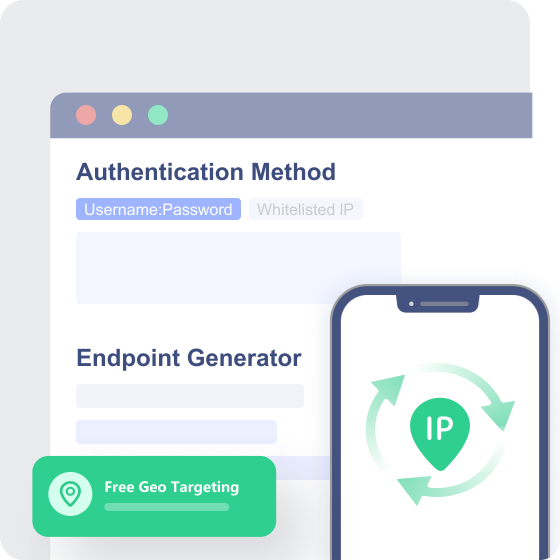
At SKYiProxy, our residential and mobile proxies come with automatic rotation settings. You can set them to rotate on every new connection, ensuring that no target site ever sees the same IP twice in a short period. This makes it nearly impossible for them to track your activity based on IP address alone.
3. Rotate User-Agents and Headers
Every HTTP request sends a "User-Agent" string that tells the server which browser and operating system you are using (e.g., Chrome on Windows 10). Default scraping libraries (like Python's Requests or Scrapy) often identify themselves as "python-requests/2.25.1", which is an immediate red flag.
To avoid detection:
- Use Real User-Agents: clear list of valid user-agent strings from modern browsers (Chrome, Firefox, Safari, Edge).
- Rotate Them: Just like IPs, rotate your User-Agent string with every request.
- Match Headers: Ensure your other HTTP headers (Accept-Language, Referer, Accept-Encoding) match the behavior of the browser specified in your User-Agent. A mismatch (e.g., claiming to be Chrome but missing standard Chrome headers) is a dead giveaway.
4. Implement Delays and Throttling
Humans don't browse websites at the speed of light. They take time to read, click, and scroll. Bots, on the other hand, can request hundreds of pages per second. This "superhuman" speed is the easiest way to get caught by rate-limiting algorithms.
Solution: Slow down. Add random delays between your requests (e.g., waiting 2 to 5 seconds). Randomization is key—if you request a page exactly every 3.0 seconds, patterns will emerge. Using a distribution (like a Gaussian distribution) for delays makes your behavior appear more organic.
5. Be Wary of Honeypots
Honeypots are invisible links hidden in the HTML code of a webpage. They are set to `display: none` or positioned off-screen using CSS, so human users never see or click them. However, simple bots that parse the HTML and follow every link will click them.
If you access a honeypot link, the server knows immediately that you are a bot and will block your IP. To avoid this, successful scrapers must check the CSS properties of links before following them to ensure they are actually visible to users.
6. Manage Cookies and Sessions
Websites use cookies to track user sessions. If you send requests without cookies, or with cookies that don't make sense (e.g., tracking a user journey that skips steps), you might get flagged.
Conversely, if you keep the same cookies while rotating IPs, you are essentially waving a flag saying, "It's still me, just changing masks!" If you rotate your IP, you must usually clear or rotate your cookies as well, effectively starting a fresh session.
7. Handle CAPTCHAs Gracefully
Even with the best precautions, you might trigger a CAPTCHA (like reCAPTCHA or hCaptcha). Repeatedly failing a CAPTCHA or trying to bypass it blindly often leads to a hard ban.
- Detection: Your scraper should be able to detect when a CAPTCHA page is returned instead of the content.
- Backoff: If a CAPTCHA appears, stop scraping that page with the current IP immediately.
- Solvers: Integration with 3rd-party CAPTCHA solving services can help, but preventing the CAPTCHA from appearing in the first place (through better proxies and fingerprints) is the best strategy.
8. Use Headless Browsers
For highly dynamic sites (Single Page Applications using React, Vue, or Angular) or sites with heavy fingerprinting, simple HTTP requests might not work. In these cases, using a headless browser (like Puppeteer, Selenium, or Playwright) is necessary.
Headless browsers render the JavaScript just like a real browser. While they are slower and more resource-intensive, they pass many rigorous bot checks that simple scripts fail. Tools like `puppeteer-extra-plugin-stealth` can further hide the automation traces of these browsers.
Conclusion
Avoiding IP bans is a continuous game of cat and mouse. As websites get smarter, scrapers must adapt. The foundation of any unblockable scraping setup, however, remains the same: High-quality proxies.
No matter how perfect your script is, if you use a flagged IP, you will fail. SKYiProxy provides the elite residential and mobile proxies you need to stay anonymous. With our vast pool of high-trust IPs, automatic rotation, and ethical sourcing, you can scrape with confidence. Try SKYiProxy today and stop worrying about bans.